








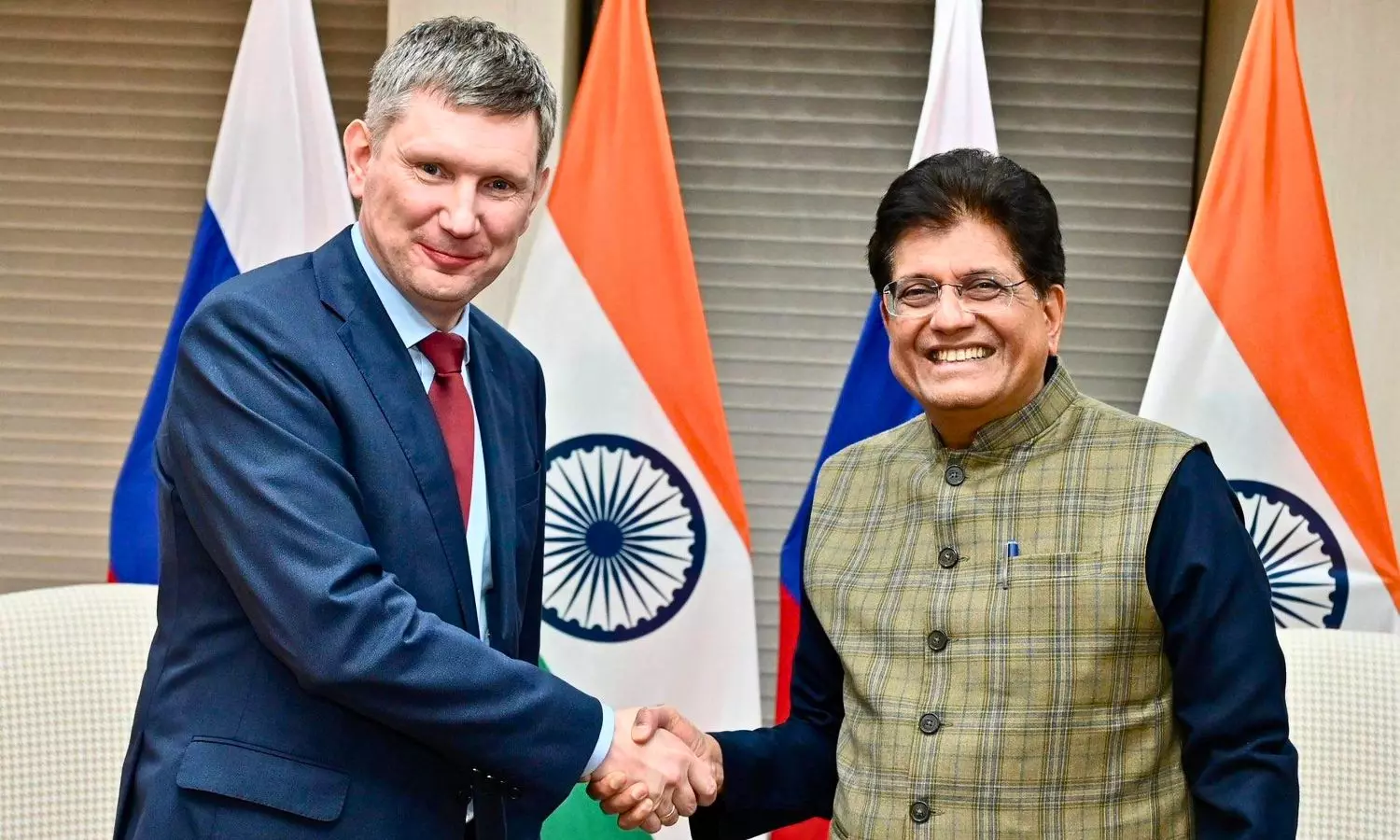
India and the Eurasian Economic Union (EAEU) are exploring a limited and temporary trade arrangement covering select categories of goods as part of ongoing negotiations for a broader free trade agreement (FTA). The development was revealed by Russia’s Economic Development Minister Maxim Reshetnikov, who described the talks as challenging due to the scale and complexity of the Indian economy.
Speaking in an interview with the Vesti programme, Reshetnikov said that India’s demands in the negotiations were “quite ambitious,” making the discussions more complicated than similar agreements with other countries. As a result, both sides are currently considering a restricted free trade framework that would initially apply only to specific product groups rather than a comprehensive agreement covering all sectors.
His comments came shortly after Russian President Vladimir Putin stated that trade liberalisation talks between India and the EAEU had gathered significant momentum. Addressing a meeting of the Supreme Eurasian Economic Council in Astana, Kazakhstan, Putin highlighted the bloc’s recent trade agreements with Mongolia, the United Arab Emirates, and Indonesia, while also pointing to the progress being made in negotiations with India.
Putin noted that the EAEU remains open to expanding trade partnerships and will carefully evaluate all aspects of future free trade agreements. The Eurasian Economic Union consists of five member nations—Russia, Belarus, Kazakhstan, Kyrgyzstan, and Armenia—and was established in 2015 to promote economic integration through a common market, reduced trade barriers, and coordinated economic policies.
The India-EAEU FTA discussions have accelerated in recent years. A major milestone was achieved in August 2025 when both sides signed the Terms of Reference, formally launching negotiations for the agreement. At that time, bilateral trade between India and the EAEU had reached approximately USD 69 billion in 2024, reflecting a seven percent increase over the previous year. The first round of formal negotiations was subsequently held in November 2025.
As discussions continue, both sides appear focused on finding a practical path forward, with a limited trade arrangement potentially serving as a stepping stone toward a comprehensive free trade agreement in the future.
Recent Random Post: