








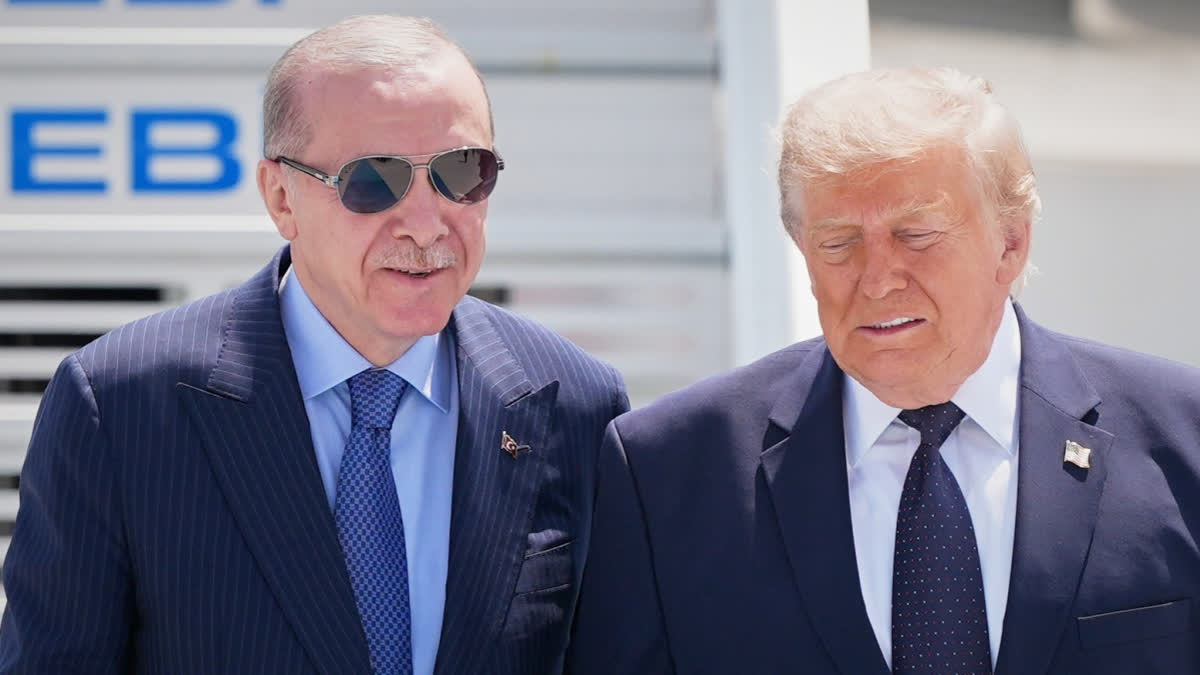
U.S. President Donald Trump arrived in Ankara on Tuesday to attend the NATO Summit, where alliance leaders unveiled a series of major defence projects and military procurement plans worth billions of dollars.
Hosted by Turkish President Recep Tayyip Erdoğan, this year’s summit is focused on strengthening NATO’s military capabilities while encouraging member nations to increase defence spending amid growing global security challenges.
Ahead of Trump’s arrival, NATO Secretary General Mark Rutte announced several multinational defence initiatives, describing them as “money well spent” to strengthen the alliance’s long-term security.
Among the key announcements was a deal under which Swedish defence company Saab will supply up to 10 GlobalEye airborne surveillance aircraft to a consortium of 10 NATO member nations. The new aircraft will gradually replace NATO’s ageing fleet of AWACS early-warning planes, many of which have been in service for nearly five decades.
NATO also confirmed plans for a four-country initiative to purchase up to five Triton surveillance drones, further enhancing the alliance’s intelligence and reconnaissance capabilities. In another major project, representatives from 15 member countries agreed to jointly acquire new air-to-air refuelling and transport aircraft from Airbus.
Many of these defence programmes are expected to receive financial support through the European Union’s defence funding mechanism, which could mobilize up to $170 billion for military investments across Europe.
The announcements come as President Trump continues to push NATO allies to spend more on defence. Trump has repeatedly argued that European nations should shoulder a greater share of the alliance’s security responsibilities, while the United States focuses more on the Indo-Pacific region and challenges posed by China.
Speaking at the summit, U.S. officials emphasized the need to significantly expand defence production and strengthen cooperation with European allies to meet growing security demands.
Another major issue surrounding the summit is the possibility of the United States resuming sales of F-35 fighter jets to Turkey. Ankara was removed from the F-35 programme in 2019 after purchasing Russia’s S-400 missile defence system.
Israeli Prime Minister Benjamin Netanyahu has publicly opposed any move to restore F-35 sales to Turkey, arguing that such a decision could alter the strategic balance in the Middle East. Turkey and Israel continue to have strained relations, particularly over the ongoing conflict in Gaza.
Security was significantly tightened across Ankara for the summit, with authorities imposing restrictions on protests. A small demonstration by student activists was quickly dispersed by police, and several protesters were reportedly detained.
The broader objective of the summit is to redefine NATO’s future strategy by encouraging European members to take greater responsibility for regional security. The alliance is also seeking to boost military readiness amid continued concerns over Russia’s actions in Ukraine and the possibility of future hybrid threats across Europe.
With defence spending, military modernization and burden-sharing dominating the agenda, the summit is expected to shape NATO’s strategic direction in the years ahead.
Recent Random Post: