








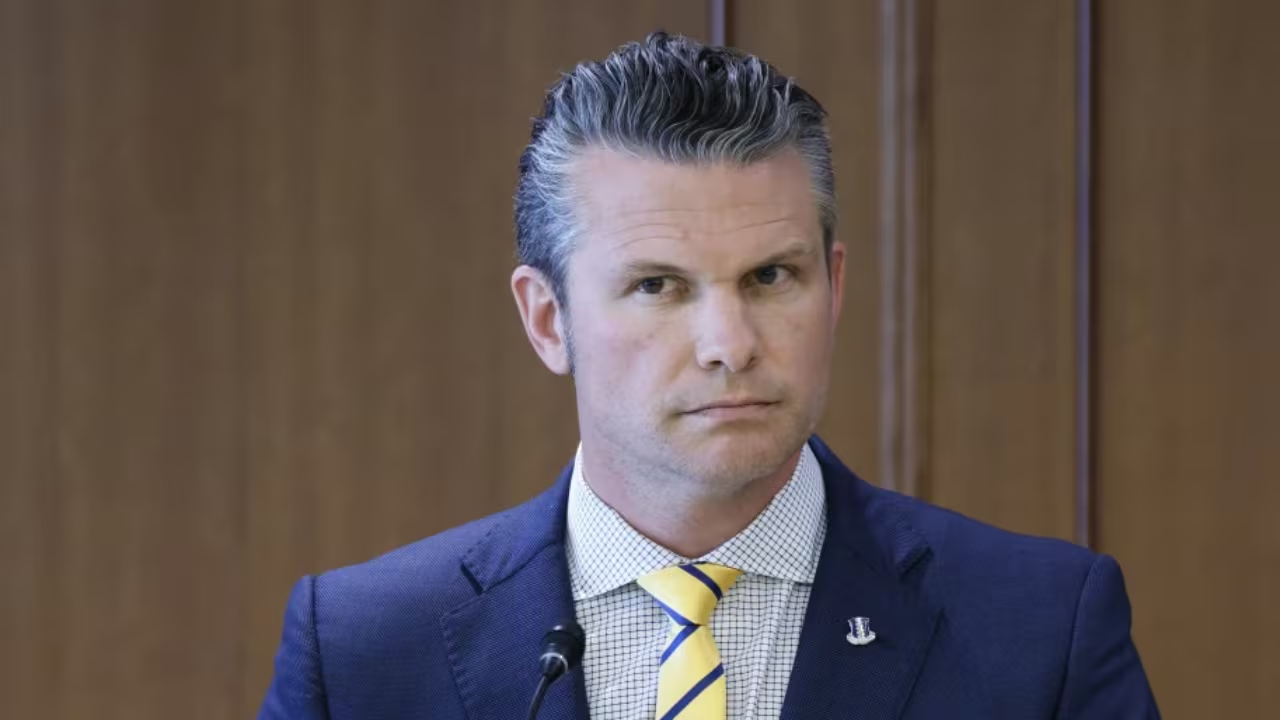
U.S. Defense Secretary Pete Hegseth has reassured America’s Pacific allies that Washington remains firmly committed to the Indo-Pacific region, while striking a more measured tone on China compared to his previous remarks. Speaking at the Shangri-La Dialogue in Singapore, a major defense and security conference attended by global leaders, diplomats, and top military officials, Hegseth emphasized that the region holds “profound implications for U.S. security and prosperity.”
He stated that Washington’s priority is to maintain a “lasting and favorable balance of power in the Pacific,” signaling continued strategic engagement in the region. This year’s remarks were notably more restrained, especially when compared to his earlier warning at the same forum, where he had described China as rapidly building military capabilities, particularly in relation to Taiwan.
His softened stance comes in the backdrop of recent diplomatic engagements between U.S. President Donald Trump and Chinese President Xi Jinping, where both sides reportedly discussed improving bilateral relations. Following their meeting, Trump referred to Xi as a “great leader” and expressed optimism about future cooperation.
Despite the toned-down rhetoric, Hegseth reiterated that it remains a U.S. priority to prevent any single power from dominating the Indo-Pacific region. He highlighted concerns over China’s expanding military presence and said there is shared understanding among allies that a region dominated by a hegemon would destabilize the existing balance.
He also reaffirmed that there is “no change in U.S. policy” regarding Taiwan, although he declined to comment on pending arms sales decisions. Taiwan continues to remain a sensitive geopolitical issue, with the U.S. maintaining a policy of strategic ambiguity while legally supporting Taiwan’s self-defense capabilities.
During his address, Hegseth also emphasized that U.S. allies must increase defense spending, stating that America seeks “partners, not protectorates.” He praised several Asian nations for boosting their military investments while indirectly criticizing some European allies for focusing too much on ideological rhetoric rather than practical security cooperation.
In response, Australian Defense Minister Richard Marles noted that while the global rules-based order is imperfect, it must be strengthened rather than weakened, stressing that smaller nations rely on consistent global norms to safeguard their sovereignty.
The conference underscored shifting global dynamics, with the U.S. balancing strategic competition with China while attempting to maintain diplomatic flexibility and stronger regional partnerships across the Indo-Pacific.
Recent Random Post: