








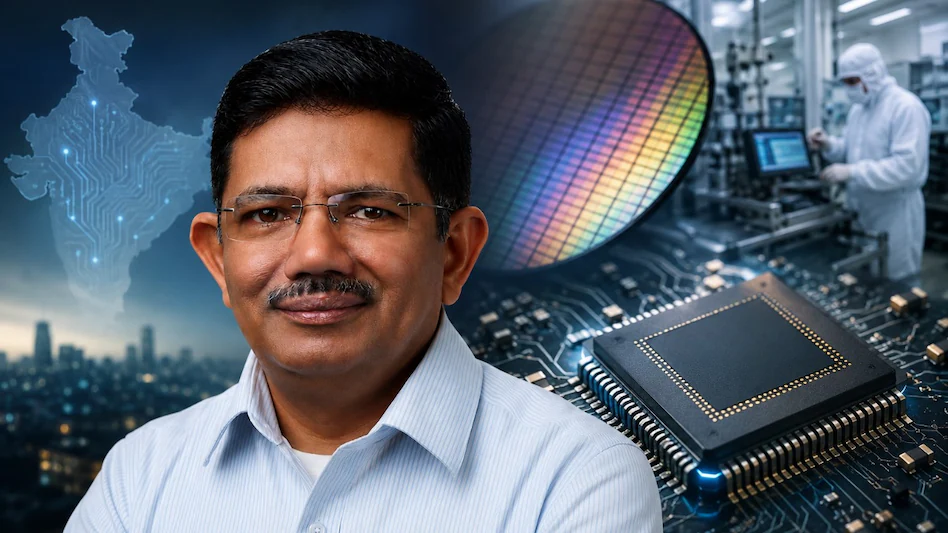
Artificial intelligence (AI) may currently dominate boardroom discussions, investor presentations, and government policy agendas, but according to Gilroy Mathew, Chief Operating Officer of AI and technology solutions company UST, the real long-term battle for control of the technology ecosystem will be decided in semiconductors.
As global demand for AI infrastructure, advanced computing, and connected devices continues to surge, Mathew argues that chips—not just AI applications—will ultimately define who controls the economics, scalability, and strategic direction of the next technology era.
“Control over silicon increasingly determines the efficiency, scalability, and economics of AI systems, making semiconductors a foundational strategic lever in the broader technology landscape,” Mathew told Business Today. He added that semiconductors and AI are deeply interconnected layers of the same technology stack rather than competing priorities.
Mathew believes India’s semiconductor opportunity stands apart from earlier technology waves such as outsourcing, cloud computing, and digital transformation. He said it represents not just a services play, but a strategic shift toward manufacturing, design, and national capability building.
UST’s journey in the semiconductor space reflects this evolution. The company entered the sector in 2009 with a small engineering team and later strengthened its capabilities in 2018 through the acquisition of Bengaluru-based SeviTech Systems, a VLSI services firm. By 2023–24, UST was working with 35 leading global semiconductor companies across the full silicon lifecycle, including chip design, validation, and embedded software development. In late 2025, it further expanded its footprint by partnering with Kaynes Semicon to establish a ₹3,330 crore Outsourced Semiconductor Assembly and Test (OSAT) facility in Sanand, Gujarat.
Today, UST operates across multiple countries including the United States, Europe, Malaysia, Mexico, Puerto Rico, and several Indian tech hubs such as Bengaluru, Pune, Hyderabad, and Noida. Mathew said the next phase of growth for Indian IT and engineering firms will require moving beyond talent supply toward ownership of larger semiconductor programmes and end-to-end delivery responsibilities.
He noted that while Indian firms currently excel in areas like verification, validation, embedded software, and testing, global clients are increasingly seeking partners capable of managing full engineering programs and delivering measurable silicon outcomes.
While semiconductor fabrication remains a long-term goal due to its high capital requirements, Mathew sees strong near-term potential for India in chip design, advanced packaging, and embedded systems.
He highlighted that India already contributes nearly 20% of the world’s chip design engineering talent, providing a strong foundation for growth in design-led innovation. Government initiatives such as the India Semiconductor Mission, along with private investments in OSAT and ATMP projects, are gradually moving from policy to execution.
However, he cautioned that India must avoid competing solely on cost and scale. Instead, he emphasized the need to build trust, specialised expertise, reusable engineering assets, and the ability to consistently deliver high-quality global programmes.
Mathew pointed out that in previous technology shifts like cloud and SaaS, Indian IT firms achieved global scale but much of the core intellectual property and platform value remained with global product companies. He believes semiconductors could offer India a chance to change that pattern by moving higher up the value chain.
He also stressed that semiconductors are not just a technology industry but a strategic foundation for sectors such as defence, automotive, healthcare, telecom, AI, and global supply chain resilience.
However, he warned that building leadership in this space will take decades of sustained investment, ecosystem maturity, and deep technical expertise.
Looking ahead, Mathew said AI-driven automation will significantly disrupt parts of the IT services industry over the next five years, especially roles involving repetitive and manual execution such as application maintenance and basic testing.
As these layers become increasingly automated, the industry will shift toward more complex, engineering-led work that cannot be easily commoditised.
For India, he believes the biggest opportunity lies in combining strengths in software with emerging semiconductor capabilities. The future, he said, is in building integrated systems where chips, embedded software, and cloud technologies come together to create end-to-end intelligent solutions.
Recent Random Post: