









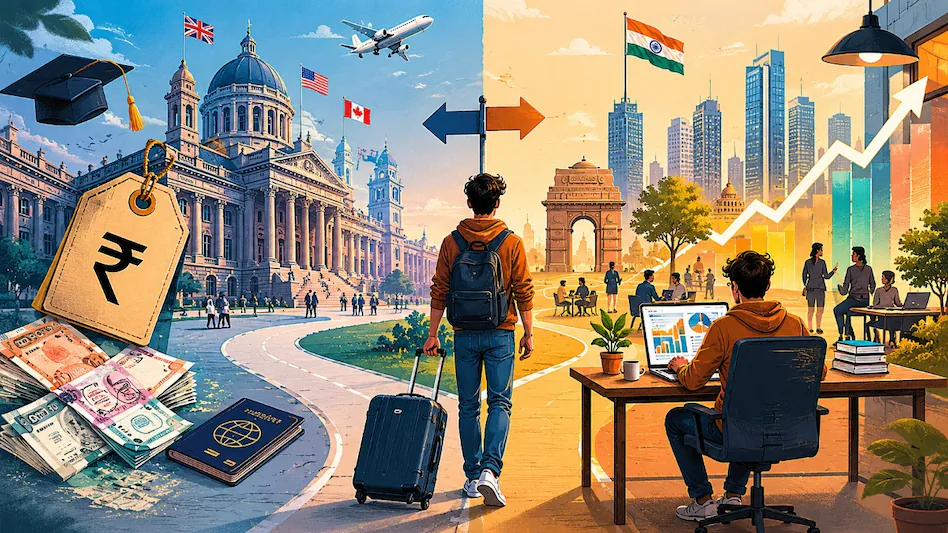
For years, studying abroad was considered a pathway to better careers, global exposure, international mobility, and opportunities that many believed were difficult to access in India. However, in 2026, that dream has become far more complicated and financially demanding. With tuition fees, living expenses, and currency fluctuations pushing the total cost of overseas education beyond ₹50–70 lakh in many cases, Indian students and parents are now questioning whether a foreign degree still offers worthwhile returns on investment.
Education experts say the answer is no longer straightforward. Students today can no longer choose universities purely based on global rankings or brand value. Instead, the focus has shifted toward practical career outcomes, employability, financial sustainability, and immigration stability. According to experts, internship opportunities, industry exposure, alumni outcomes, local job demand, salary potential, employer networks, and post-study work opportunities now matter far more than university prestige alone.
Experts also point out that the actual course and the job market connected to it are often more important than the country itself when evaluating long-term career returns. Students are now being advised to carefully examine factors such as internship access, placement opportunities, expected salaries after graduation, education loan repayment timelines, accommodation costs, and long-term immigration policies before making decisions.
One of the biggest concerns today is the tightening immigration environment across major study destinations like the United States, United Kingdom, Canada, and Australia. Countries that once openly welcomed international students are now introducing stricter visa scrutiny, tighter migration policies, and increased monitoring of work permits. As a result, students and families are becoming far more cautious about whether studying abroad will truly lead to stable long-term career opportunities.
At the same time, inflation, layoffs, and rising living expenses in Western economies have increased financial uncertainty. Experts warn that many families still underestimate the actual cost of overseas education. Beyond tuition fees, expenses related to accommodation, healthcare, insurance, transportation, visa processing, flights, security deposits, and currency depreciation can significantly increase the financial burden over two or three years.
Industry estimates suggest that the weakening Indian rupee alone has added nearly ₹5–8 lakh annually to overseas education expenses for many Indian families. Between 2021 and 2025, tuition fees and living costs across major destinations such as the US, UK, Canada, Australia, Germany, and France reportedly increased by nearly 35–40%.
This situation becomes even more concerning because a growing number of Indian students now depend on education loans to finance foreign studies. Experts caution students against taking massive financial risks if their entire repayment plan depends on immediately securing a high-paying job abroad after graduation.
Despite these concerns, overseas education still offers strong long-term value for students pursuing specialised and globally relevant fields. Courses related to artificial intelligence, cybersecurity, healthcare, engineering, finance, climate technology, data science, and advanced research continue to see strong international demand and promising career prospects.
Experts also say that international education provides advantages beyond salary alone. Students gain access to multinational work environments, global research ecosystems, multicultural exposure, and professional networks that can create long-term career benefits.
At the same time, India’s rapidly growing startup ecosystem, digital economy, and expanding corporate sector have changed the conversation around higher education. Top Indian institutions are increasingly delivering strong return on investment at significantly lower costs compared to overseas education.
For students planning careers in India’s fast-growing sectors such as technology, consulting, entrepreneurship, finance, and digital businesses, a quality Indian degree combined with upskilling and strategic investments may offer a safer and more financially stable path.
However, experts warn against comparing Indian and foreign degrees purely based on salary figures. Students studying abroad often gain earlier access to global labour markets, multinational employers, international peer networks, and multicultural professional exposure.
Ultimately, experts believe the biggest shift in 2026 is that overseas education is no longer viewed simply as a prestige symbol. Instead, it is increasingly being treated as a major long-term financial and career investment decision. The value of a foreign degree now depends on whether students choose the right course, in the right country, at the right cost, with a realistic understanding of future opportunities and challenges.
For some students, overseas education may still deliver excellent long-term rewards. But for others, especially those targeting industries rapidly expanding within India itself, investing wisely in domestic education, skills, and career opportunities may prove equally valuable — and sometimes far less risky.
Recent Random Post: